
CEEPR Working Paper
2026-10
Nicolas Trosino, John E. Parsons, Ruaridh Macdonald, Charles Forsberg, and Yannick Perez
Thermal Energy Storage (TES) is a promising technology to reconcile the economic constraints of capital-intensive low-carbon thermal generators such as nuclear power plants with the operational flexibility required in deeply decarbonized systems. The increasing penetration of variable renewable energy drives a growing spread in the marginal value of generation across hours through a day and throughout the year. On the one hand, when renewables are plentiful and net load is small or even zero, the marginal value of generation is zero. On the other hand, when there is a drought of renewable energy and net load threatens to exceed firm capacity, the marginal value of generation spikes. Integrating Thermal Energy Storage enables baseload production of heat, even during hours when the marginal value of electricity is low, which can then be converted to electricity when the marginal value of generation is high. This creates a new operational paradigm in which nuclear assets can behave simultaneously as firm baseload providers to maximize rate-of-return and as flexible resources to match system needs.
We employ the GenX Capacity Expansion and Dispatch Model to assess the system value of integrating Thermal Energy Storage into a fusion power plant. We parameterize our GenX model to match a 2050, deeply decarbonized New England grid, and we use GenX to co optimize investment and hourly operation across a portfolio of competing low carbon technologies. Our results show that Thermal Energy Storage fundamentally reshapes the economic frontier for fusion, dramatically increasing the breakeven cost at which investment is cost-effective for the grid, from 8,000 $/kWe up to 19,000 $/kWe. Incorporating TES and therefore deploying fusion compresses the spread in the marginal value of generation across hours of the day and through seasons of the year. Our model optimizes the size of the TES energy reservoir as well as the size of the turbine generating electricity. The optimized TES includes a very large energy reservoir, giving the TES the ability to deliver power for a long duration of 10 hours. We analyze the operation of the TES and contrast it with the operation of other storage technologies.
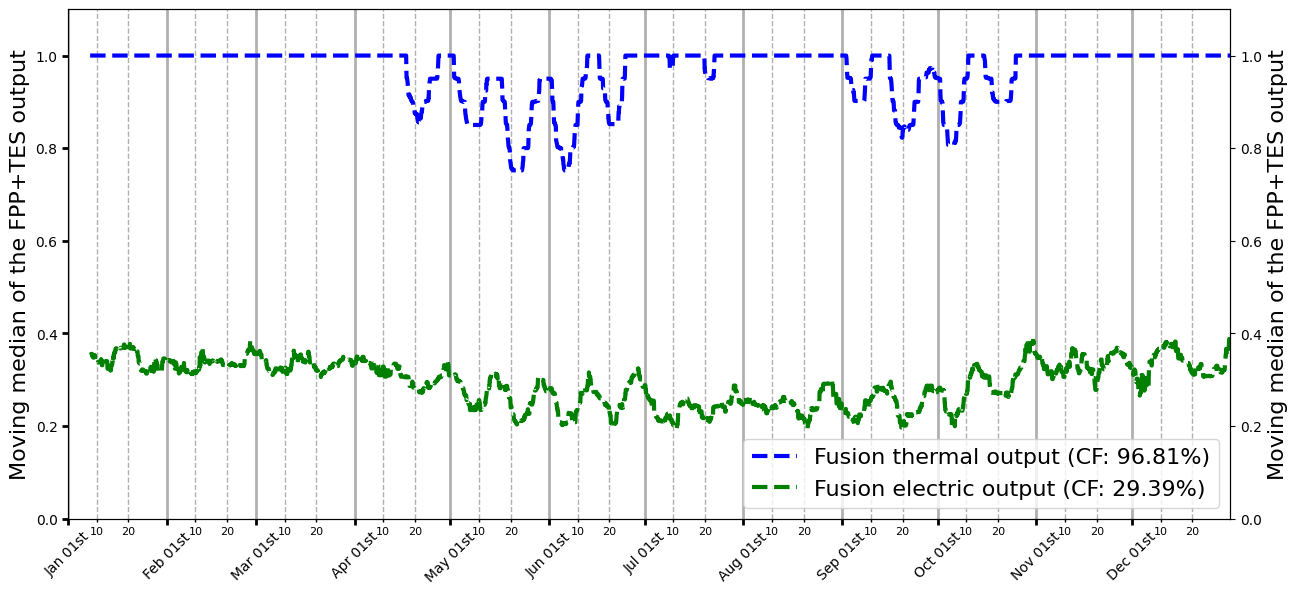
Figure 1: Median weekly heat and electricity production through an average year.
We use the GenX model described in Armstrong et al. 2024. Generating technologies available in the model include utility-scale PV, commercial rooftop PV, residential PV, onshore wind, fixed offshore wind, floating offshore wind, legacy run-of-river hydro, natural gas combined-cycle, and natural gas combined-cycle outfitted with carbon capture and sequestration. Storage technologies include legacy pumped hydro-facilities as well as Li-ion batteries. Notably, since New England imports a significant amount of power from Quebec’s large hydro system, the model also includes an hourly load profile in Quebec, together with an hourly water inflow profile, and the model optimizes the exports of power to New England while respecting specified reservoir system constraints such as minflow and seasonal maximum capacities. A distinctive feature of that model is its parameterization with 20 scenario years for hourly load and wind and solar resource availability, so that the chosen portfolio of investments must be robust across the range of scenario years. In this paper, the carbon limit is 12 gCO2/kWhe, a 95 % reduction relative to 1990.
Alongside the other generation technologies, Armstrong et al. 2024 introduce a tokamak-type fusion power plant. The representation of a thermal power plant in GenX involves only a few essential parameters, such as thermal efficiency and operational constraints, and does not require elaboration of the many details particular to this or that fusion plant. Nevertheless, to fix ideas, we briefly describe a few selected features of a generic, imagined deuterium-tritium magnetic confinement fusion power plant. The base case plant’s total thermal power capacity to 1,095 MWth. Turbine efficiency is 40 %, in which case the plant’s gross electric power capacity is 438 MWe. Some 111 MWe of power is needed for station load within the plant to cool the magnets, drive the fusion reactor, pump the molten blanket, and supply electric power for the tritium processing system and other plant operations. Thus, the net electric capacity is 327 MWe. For our modeling, it will be important to understand how the station load varies as the thermal power is ramped down. Besides a permanent station load of 10 MWe, we assume FixedSL = 10 MWe is the fixed load and VarSL = 0.083 MWe/MWth is the variable load. The Fusion Power Plant can balance its self-consumption by collecting part of its electricity generation or by consuming electricity from the grid. Overall, the plant’s heat-to-electricity efficiency is ηFPP = 29.4 %.
We model the TES in a direct architecture in which the fusion plant provides thermal energy to the salt loop which independently supplies the turbine loop. The TES charges when the plant provides more energy to the salt loop than the salt loop discharges to the turbine, and excess salt is transferred from the cold tank (light blue) to the hot tank (light red). Conversely, the TES discharges when the salt loop discharges more energy to the turbine than it receives from the plant, transferring salt from the hot tank to the cold tank and boosting generation at the turbine.
Table 1 shows the optimized portfolio and dispatch, first assuming the fusion plant is only available without TES, and second assuming TES is integrated into the fusion power plant. The assumed cost of the base fusion plant is $8,500/kWe. At that cost, and without TES, the optimized portfolio does not include any investment in fusion capacity. However, when TES is integrated into the fusion plant, the optimized portfolio does include investment in fusion capacity—7.7 GWe of turbine capacity generating 17.46 TWh of electricity.
Our model optimally sizes both the power and the energy capacity of the TES, and we find that it chooses very long durations. The TES has a lower turnover than grid batteries, but a higher utilization. The TES captures a higher spread on its turnovers than grid batteries, and its operating profitability is more concentrated in a fewer number of hours.
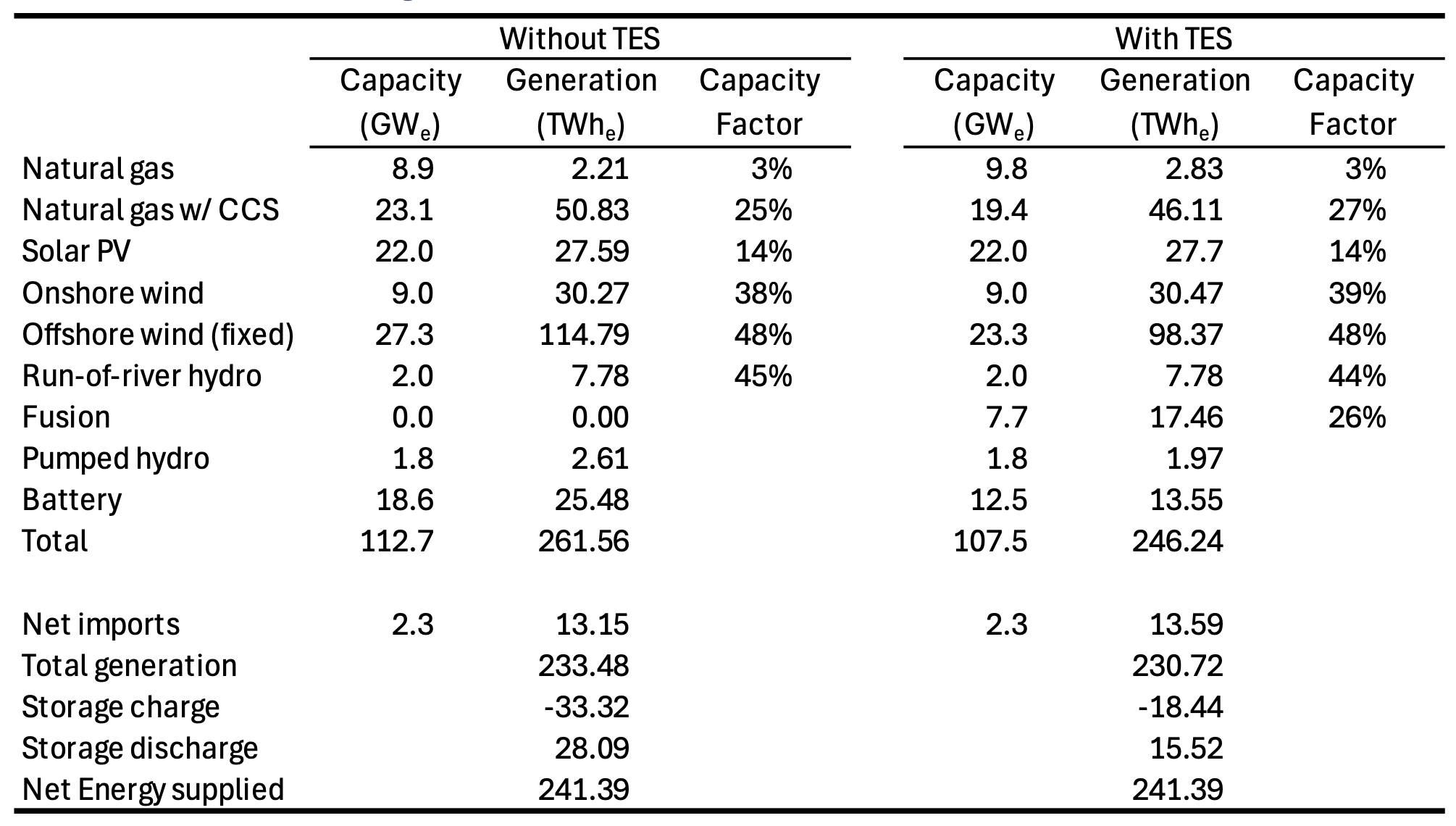
Table 1: Optimized Capacity Portfolios and Dispatch, Without and With TES Integrated with the Fusion Power Plant.
Link to the full working paper and full citations:
MIT CEEPR Working Paper 2026-10
About The Authors