


CEEPR Working Paper
2026-07
Dirk Lauinger, Deepjyoti Deka, and Sungho Shin
n the 1980s and 1990s, deregulation was en vogue. By breaking up established monopolies, the hope was to increase market efficiency by stimulating competition across various industries, including electricity. In the US, for example, the state of Massachusetts separated electricity generation from distribution and transmission, which were to be kept as regulated monopolies. The rationale for the separation was to increase competition in generation while avoiding any “cross-subsidization of competitive businesses from regulated businesses and discriminatory policies affecting access to distribution and transmission networks upon which all competitive suppliers depend” (Joskow, 2008, p. 12).
In the context of the separation between generation and distribution, storage investment and operation within electricity markets warrant a closer look. Storage has generally been considered generation, but can be considered distribution if it serves grid reliability or defers grid investments such as substation or line upgrades. In the latter case, utilities have been allowed to own and operate storage for distribution needs. Such needs are generally infrequent, especially if they arise from reliability during extreme events. Storage built to address grid reliability thus experiences low utilization, on the order of one discharge cycle per month in some cases (Orange and Rockland Utilities, 2024), and foregoes potential revenue from participating in electricity markets. Allowing for market participation would improve storage economics but risk incentivizing investments that go beyond serving local distribution needs, which would run contrary to the separation of distribution from generation.
Here, we study policy designs that allow for utility-owned storage to participate in wholesale electricity markets while constraining the level of storage investment to local distribution needs. To identify permissible storage investments, we design a model that calculates optimal degrees of investment in grid assets, such as substation and line upgrades, and non-grid resources, such as storage and backup generation. Crucially, this investment model incorporates legal market participation constraints, which limit the generation from non-grid resources to serving local distribution needs. Next, we quantify the economic gains from participation in arbitrage and capacity markets, and analyze if the gains lead to storage investments that go beyond meeting local distribution needs.
Our study is timely as US utility spending on distribution grids has increased by 45% from the year 2018 through 2023 and now stands at over $50 billion annually (Aniti, 2024). In addition, some deregulated states, i.e., Maryland (2019, p. 2) and New York (2021, pp. 12—13), have recently allowed market participation, hoping to reduce costs and recognizing that utility-owned distribution-grid storage is unlikely to exert substantial market power as it constitutes less than 1% of total US electricity generation capacity. On the other side of the Atlantic, the European Commission (2023, § 5) recommends exploring the full flexibility potential of energy storage in distribution grids and entertains proposals to create a market for local services that would help alleviate distribution grid constraints (ACER, 2025, Art. 29, 34, 40, 41, 44).
Specifically, we address three research questions about the value of storage in distribution grids:
How to model market participation constraints in storage operation and investment planning;
How do profits from market participation compare to savings from reducing peak demand;
Would market participation generate storage investments that go beyond distribution needs, and if so, how can this be detected?
We model market participation constraints by limiting the supply from non-grid resources, such as storage, to the shortfall of grid capacity relative to electricity demand. We integrate these constraints into an optimization problem that determines investment decisions and mimics integrated resource planning by distribution grid companies. As the constraints are nonconvex, they increase the computational complexity of the problem, raising questions about tractability. In a Massachusetts case study, we find that problems with a 26 year horizon and hourly resolution can be solved within several hours on current compute servers.
The case study further reveals that arbitrage and capacity market participation each generate about 50% of the capital cost savings from reducing or deferring grid investments by increasing storage utilization, see Figures 1 and 2. We determine storage investment levels appropriate for serving local distribution needs by solving the planning problems with the market participation constraints. We find that under current technology costs, market participation does not generate any storage investment that go beyond distribution needs.
Battery storage can thus be used more efficiently by providing distribution grid services and participating in electricity markets. These efficiency gains could be realized by (i) allowing and incentivizing distribution companies to participate in electricity markets, (ii) incentivizing distribution companies to contract third-party storage that also participates in electricity markets, (iii) creating a market for distribution grid services, potentially relying on nodal pricing in distribution networks (Sotkiewicz and Vignolo, 2006), or a combination of these approaches. We now discuss how our findings inform each of these options.
Regarding market participation of storage owned by distribution companies, our model can be used to estimate the value of such a policy change. In the past, the prospect of reduced or deferred grid investments was large enough to cast aside fears about market distortion, and regulators allowed storage investment for distribution needs. Market participation promising similar savings may prompt regulators to reconsider existing policies that restrict market participation for storage assets owned by distribution companies. There is a risk that allowing for market participation would incentivize distribution companies to invest in storage solely for serving the market. Under current market conditions, we find that such investments are not profitable. Even if they were profitable, our model could be used to audit proposed investments and limit them to levels appropriate for addressing distribution needs. Jurisdictions that have already allowed market participation, e.g., New York and Maryland, may find our model useful to audit proposed storage investments.
Regarding distribution companies contracting third-party storage, our model can be used to inform contract terms, e.g., storage quantities, prices, and commitment durations. The substantial savings from deferring grid investments shown in our case study suggest that such contracts could be beneficial to both distribution companies and storage developers, which may make previously unprofitable storage projects viable.
A market for distribution grid services could in theory be organized similarly to existing capacity markets on the transmission level. However, each distribution grid would likely have far fewer sellers than a capacity market, which may create concerns about liquidity and market power. Our model could be used to inform the terms of the capacity auctions in such a market, e.g., price caps and product durations.
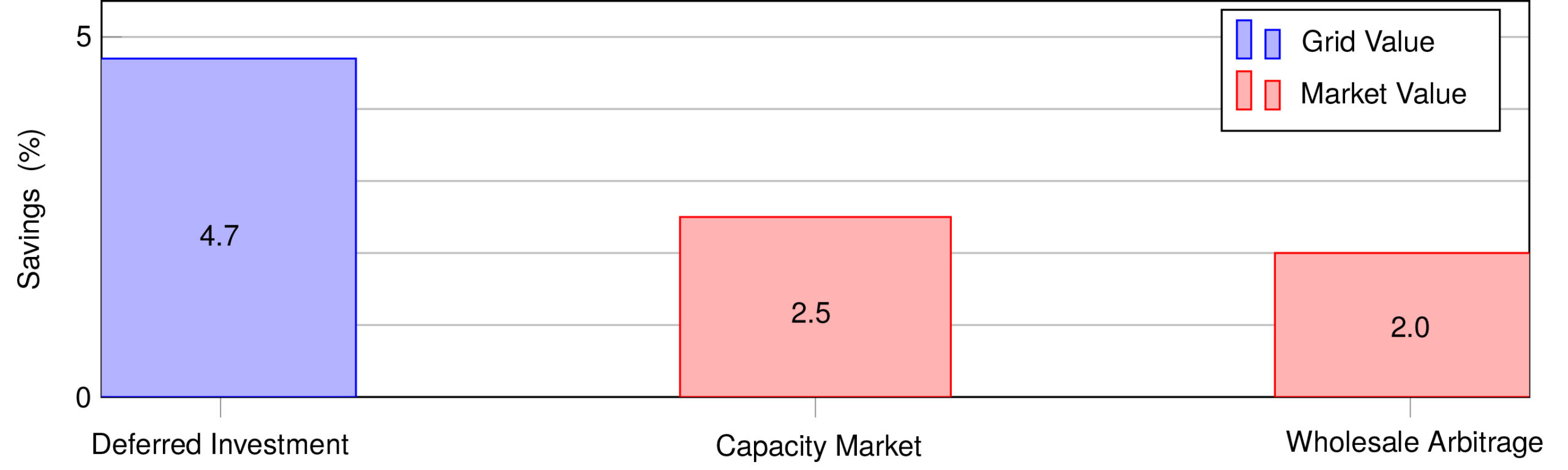
Figure 1. Savings from storage investment relative to total costs without storage investment.
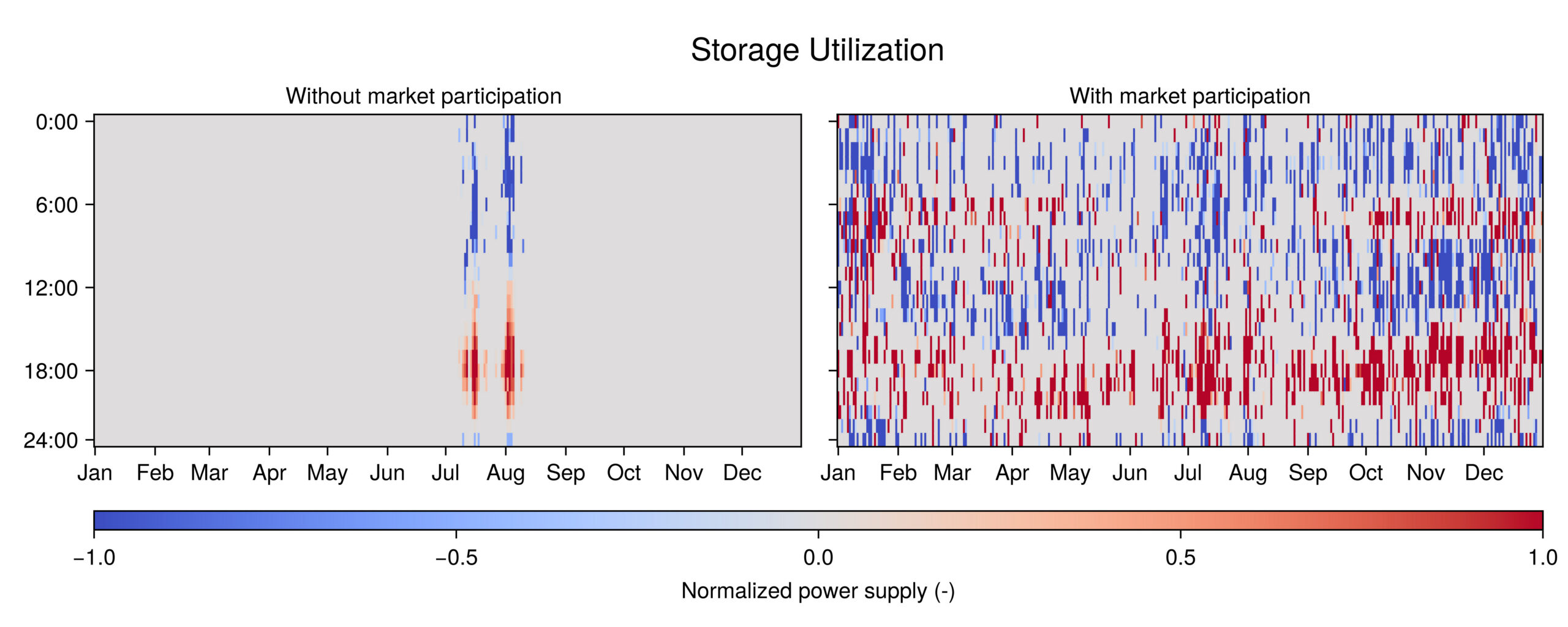
Figure 2. Storage utilization with and without market participation.
Link to the full working paper:
MIT CEEPR Working Paper 2026-07
About The Authors