


CEEPR Working Paper
2026-03
Cem Keske, Bjarne Steffen, and John E. Parsons
Electricity storage can serve the electric grid in a variety of ways. Historically, it has enabled utilities to exploit of economies of scale in generation capacity in the face of predictable diurnal variations in hourly load. Different storage technologies have been matched with different generation technologies. The large-scale expansion of pumped hydro storage in many countries between 1960 and 1990 complemented investments in baseload nuclear and coal plants. Thermal storage has been integrated into concentrated solar power plants to economize on the size of the power island in the face of dramatic, predictable diurnal variations in insolation. Grid-scale battery storage is proving a valuable complement to the large-scale penetration of solar PV, especially with regard to managing the regular evening ramp. Storage is also useful to manage the stochastic variation in load and renewable generation at short time scales. In many electric grids, battery storage is becoming an important source of frequency regulation and fast response operating reserves.
Storage assets are also now beginning to be assessed for how they can help manage stochastic variation at longer time scales. Hydro reservoir dominated grids have long managed the inventory of water in the face of seasonal and inter-annual variation in water inflows. Now, other operators managing the increasing penetration of wind and solar PV generation are also learning how to assess the danger of renewable resource droughts and attend to the stock of stored energy in their systems. Many grid operators have been working to update their metrics for resource adequacy. Capacity markets in many systems are being adapted to incorporate more sophisticated measures of how each resource contribute to system capacity, including storage assets (a.k.a. energy duration limited resources).
Our model is tailored to help illuminate how storage serves resource adequacy, especially in light of the danger of renewable resource droughts. We eliminate any deterministic calendar variations (e.g., daily cycles) and focus exclusively on optimization against a stationary uncertain inflow of renewable energy. In spirit then, this is a model more inspired by the volatility characterizing wind dominated systems than solar PV dominated systems. Our model is constructed with hourly granularity, focusing on the provision of energy, so we do not consider the provision of services at a shorter time scale such as frequency regulation, operating reserves, or other ancillary services. Subject to that proviso, the storage asset is optimized in the face of variability at all other time scales, whether hourly variations or the long-run danger of droughts.
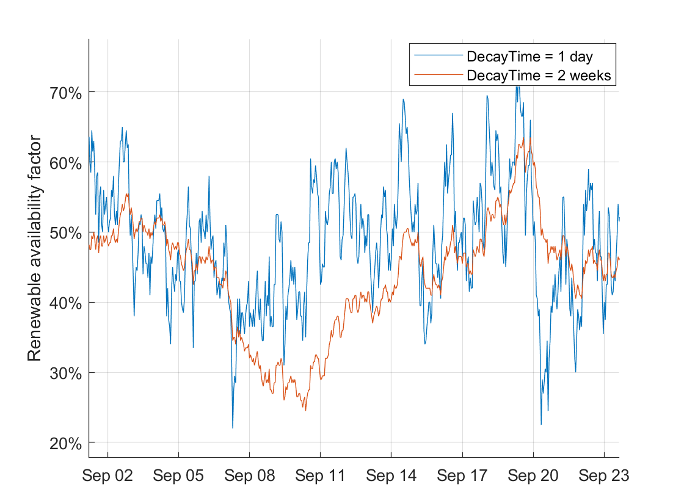
Figure 1. Two simulations of renewable availability factors reflecting different parameters for rate of decay.
Figure 1 illustrates the effect of a key parameter of our model of the uncertain availability factor of our renewable energy, the rate of decay. The figure shows two simulations of the renewable availability factor across three weeks. The two simulations have the same long-term distributions. However, they differ in the rate of decay: in the blue simulation, when the availability factor is above or below its mean value, it can be expected to return to the mean faster, while in the red simulation it is expected to return to the mean more slowly. The blue simulation experiences more frequent, but shorter scarcity events—i.e., fewer prolonged droughts. The red simulation experiences fewer, but longer lasting scarcity events—i.e., more prolonged drought episodes.
We solve for the optimal operation of a battery as a function of the rate of decay, among other drivers. Figure 2 illustrates the optimal dispatch strategy for an 8 MW, 8-hour duration battery with a 90% roundtrip efficiency on a hypothetical grid with an hourly load of 150 MW, 200 MW of renewable capacity, 60 MW of baseload thermal generation, and 40 MW of peaking thermal generation. The two dimensions of the figure define the state-space on which the dispatch can be conditioned.
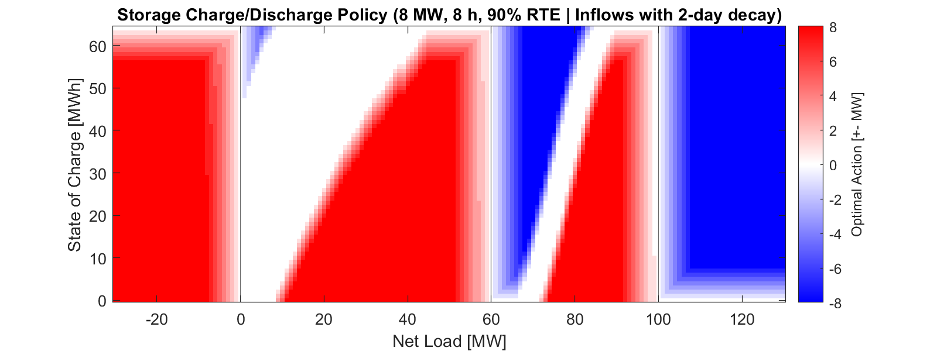
Figure 2. The optimal dispatch policy.
The horizontal axis is this hour’s net load before operation of the battery: when the renewable capacity factor is high, the net load is low. On the far left, below 0, renewable generation would be curtailed unless the battery is charging. On the far right, beyond 100, non-battery generation is insufficient to supply load and without the battery discharging there would be a loss-of-load event. Between 0 and 60 on the horizontal axis, the baseload generator is the marginal unit, while between 60 and 100, the peaking generator is marginal. The decay parameter determines how long net load can be expected to remain far from the center after an unexpectedly high or low hour.
The vertical axis is the battery’s own state-of-charge. At the top, at 64 MWh, the battery is full. At the bottom, the battery is empty.
The color scheme describes the dispatch strategy: red means it is charging, blue means it is discharging and white means it is holding its charge. Unsurprisingly, when renewables would otherwise be curtailed—on the far left—the battery is charging, and when there would otherwise be a loss-of-load event—on the far right—the battery is discharging. What the optimization informs us about is how the battery is managed in less clear cut cases: for example when net load is between 60 and 100 and the expensive peaker plant is operating. Net load is expected to move back below 60, but there is always the possibility that it might move above 100. If the battery discharges above 60 and net load does move below 60, then the battery can be recharged at the lower price determined by the baseload plant and the system has avoided utilizing the expensive peaker when net load was briefly above 60. However, if the net load stays above 60, the battery will eventually be exhausted. Then, if net load increases further, towards 100 and above, if the battery is to provide any resource adequacy, it must recharge itself using the expensive peaking generation. The optimization is the result of balancing these possibilities.
As we decrease the rate of decay, making a persistent excursion towards a loss-of-load event more likely, the space for arbitraging the peaking and baseload generator is reduced and the battery holds its charge more often.
The paper also shows how the dispatch strategy varies with the storage asset’s duration and roundtrip efficiency. We also illustrate how the dispatch of one storage asset depends on the features and state of charge of other storage assets in the system, and demonstrate conditions under which it is optimal for one asset to charge while another is discharging. Finally, we show how these drivers affect the optimal portfolio of capacities, system cost, and loss-of-load events.
Link to the full working paper:
MIT CEEPR Working Paper 2026-03
About The Authors