


CEEPR Working Paper
2026-05
Jonas Boeschemeier and Sebastian Schwenen
Electricity Markets in North America
More than two-thirds of electricity in North America is traded in deregulated wholesale markets. These markets use a system called locational marginal pricing (LMP), where generators are paid prices that reflect local supply and demand conditions at each point in the grid. These prices can vary enormously across locations, driven mainly by transmission congestion.
Consumers, however, do not pay these fine-grained prices. Instead, thousands of grid locations are grouped into a small number of broad price zones, where everyone pays the same average price. When real local scarcity is hidden behind a zone-wide average, some consumers overpay and others underpay, a mismatch that reduces the efficiency of the market.
The problem is that most zone boundaries were drawn when these markets were first set up, in some cases more than 25 years ago. In California, just three zones cover the entire state. These configurations have not kept pace with changing generation patterns, load growth, or grid constraints, as our paper shows.
A New Tool for Measuring Zone Efficiency
We develop a straightforward framework to measure how well price zones reflect actual price variation across the grid. Building on Jacobsen et al. (2020), our central metric is a new efficiency measure running from 0% to 100%, which captures how close a given zone configuration comes to perfectly efficient pricing. A score of 100% means zone prices fully reflect local conditions, with no efficiency loss from aggregation. A score of 0% means zone prices are no better than charging everyone in the market the same flat rate.
How Do Current Zones Perform?
We apply this framework to three major U.S. electricity markets using five years of hourly price data from 2020 to 2024.
– New York (NYISO) has 547 pricing nodes in our sample, grouped into 11 zones, and scores 79%. Its zones do a good job of tracking local price conditions.
– New England (ISO-NE) has 1,005 nodes in our sample and 8 zones, scoring 37%. Zones explain less of the local variation, though spatial price differences in New England are relatively small to begin with, so the efficiency loss in dollar terms remains limited.
– California (CAISO) has 1,398 nodes in our sample but only 3 zones, scoring just 29%. Performance has also been getting worse over recent years, with growing price differences within zones pointing to a configuration increasingly out of step with how the grid actually operates.
Taken together, these results suggest that existing zone boundaries, particularly in California, no longer reflect grid conditions well and that redesign is worth serious consideration.
What Would Better Zones Look Like?
To identify efficiency-maximizing alternatives, we apply machine learning clustering techniques that group nodes with similar price patterns together, following the approach of Astier (2021). Our algorithm can incorporate price data alone, or augment it with geographic coordinates and institutional boundaries to produce configurations that are both economically efficient and practically implementable.
A first takeaway is that a handful of well-designed zones already captures most of the spatial variation in all three markets, with gains diminishing quickly as more zones are added. More importantly, a substantial share of efficiency losses in each market stems not from having too few zones, but simply from having boundaries drawn in the wrong places.
That misalignment is modest in New York, where the current 11-zone configuration is close to optimal. In California, restructuring the same three zones based on price patterns would raise efficiency from 29% to 37%. The gap is largest in New England, where the current 8-zone structure scores just 37%, while an optimally assigned 8-zone configuration reaches 73%. In all three markets, an alternative fix also delivers meaningful gains: just splitting the single least efficient zone raises efficiency substantially without requiring a full redesign.
When we map the counterfactual zones, as shown in Figure 1, a striking pattern emerges: price-based clustering produces geographically contiguous regions even without using location as an input, because prices already encode the spatial structure of the grid.
– In New York, the main change is that Long Island, currently one zone, is split into three subzones.
– In New England, Rhode Island and eastern Massachusetts are merged into one zone, while Maine is split into four.
– In California, the two southern zones are consolidated into one, while the large northern zone of Pacific Gase & Electric is subdivided.
Conclusion and policy implications
Our results suggest that zone boundaries deserve more attention than they typically receive. For regulators and market operators, meaningful efficiency improvements appear achievable without radical change, often by splitting a single poorly designed zone or modestly redrawing a few boundaries. Given that grid conditions continue to evolve with the energy transition, periodic reassessment of zone configurations seems a reasonable and relatively low-cost policy step.
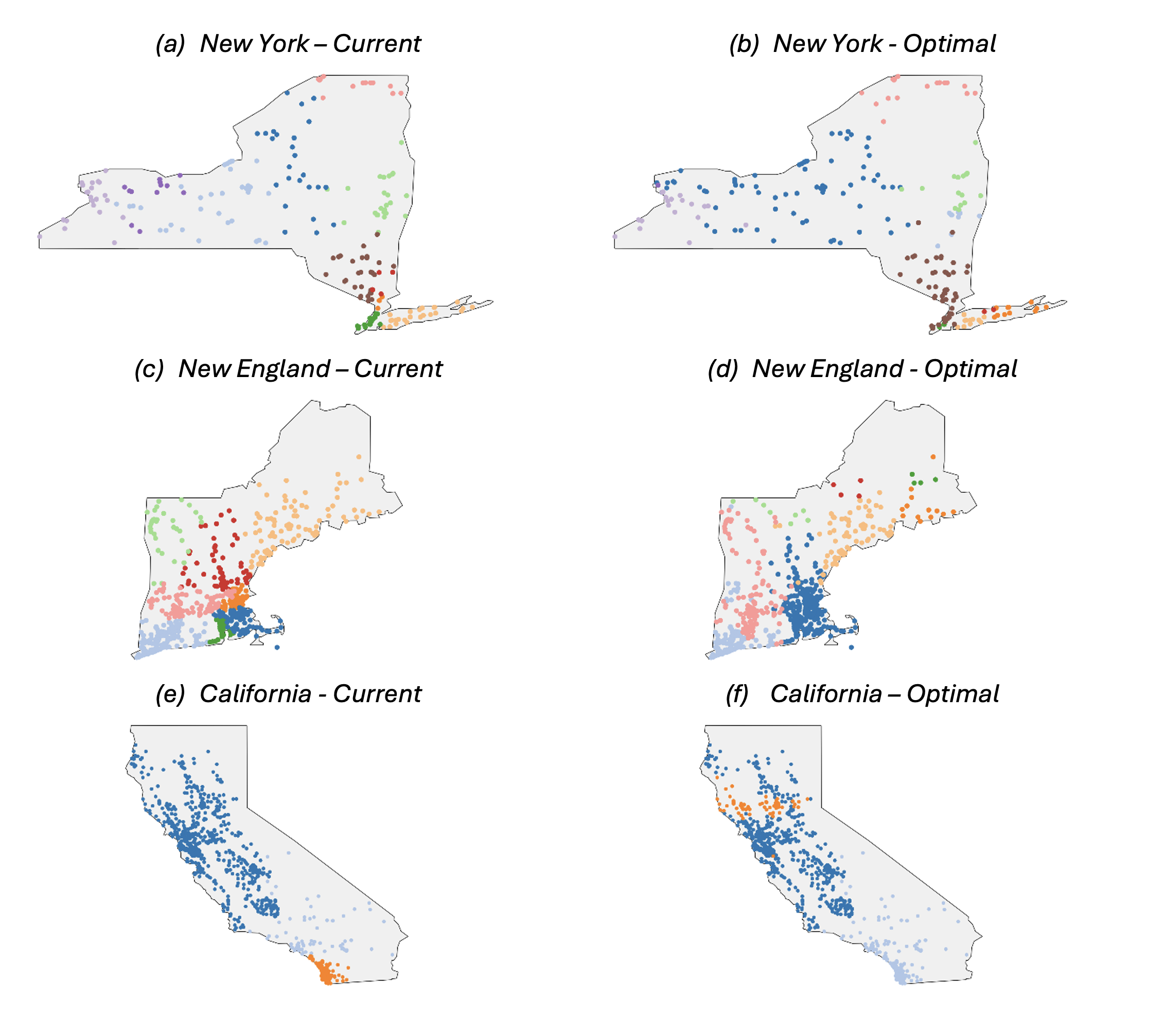
Figure 1. Current price zones vs. optimal counterfactual price zones
Link to the full working paper:
MIT CEEPR Working Paper 2026-05
About The Authors