


CEEPR Working Paper
2025-21
Eric Avis, Jing Li, and Katalin Springel
Electric vehicles (EVs) have played a central role in climate and transportation policy efforts, yet many drivers still face practical barriers to adoption. To help make EV ownership more appealing, California’s Clean Air Vehicle Decal Program granted eligible EV drivers access to high-occupancy vehicle (HOV) lanes, allowing them to bypass traffic even when traveling alone. The policy offered a direct, daily benefit that made EV ownership more attractive, particularly for commuters in congested areas such as Los Angeles, San Diego, and the San Francisco Bay Area. With the program’s expiration in September 2025, an important question arises: how much did these HOV lane privileges influence EV adoption, and which communities benefited the most?
We study this question using a detailed dataset that combines twelve years of monthly vehicle registration records with a spatial history of every HOV lane segment in California between 2012 and 2024. By tracking when and where each HOV segment became operational and matching that information to census tract-level vehicle registrations, we can observe how EV adoption changed in neighborhoods that suddenly gained HOV access compared with those that did not. We exploit the staggered expansion of the HOV network in California to isolate the policy’s causal impact on EV purchases rather than simply reflecting broader market trends. While prior research has documented sizeable effects of HOV incentives in the early years of the U.S. EV market (DeShazo et al., 2017; Jenn et al., 2018), the EV market and access to the HOV network have evolved substantially in recent years. Coupled with a longer time horizon and detailed census tract-level registration data, our study provides new evidence on how the role of HOV exemptions has changed in a more developed EV market and within a rapidly changing policy landscape.
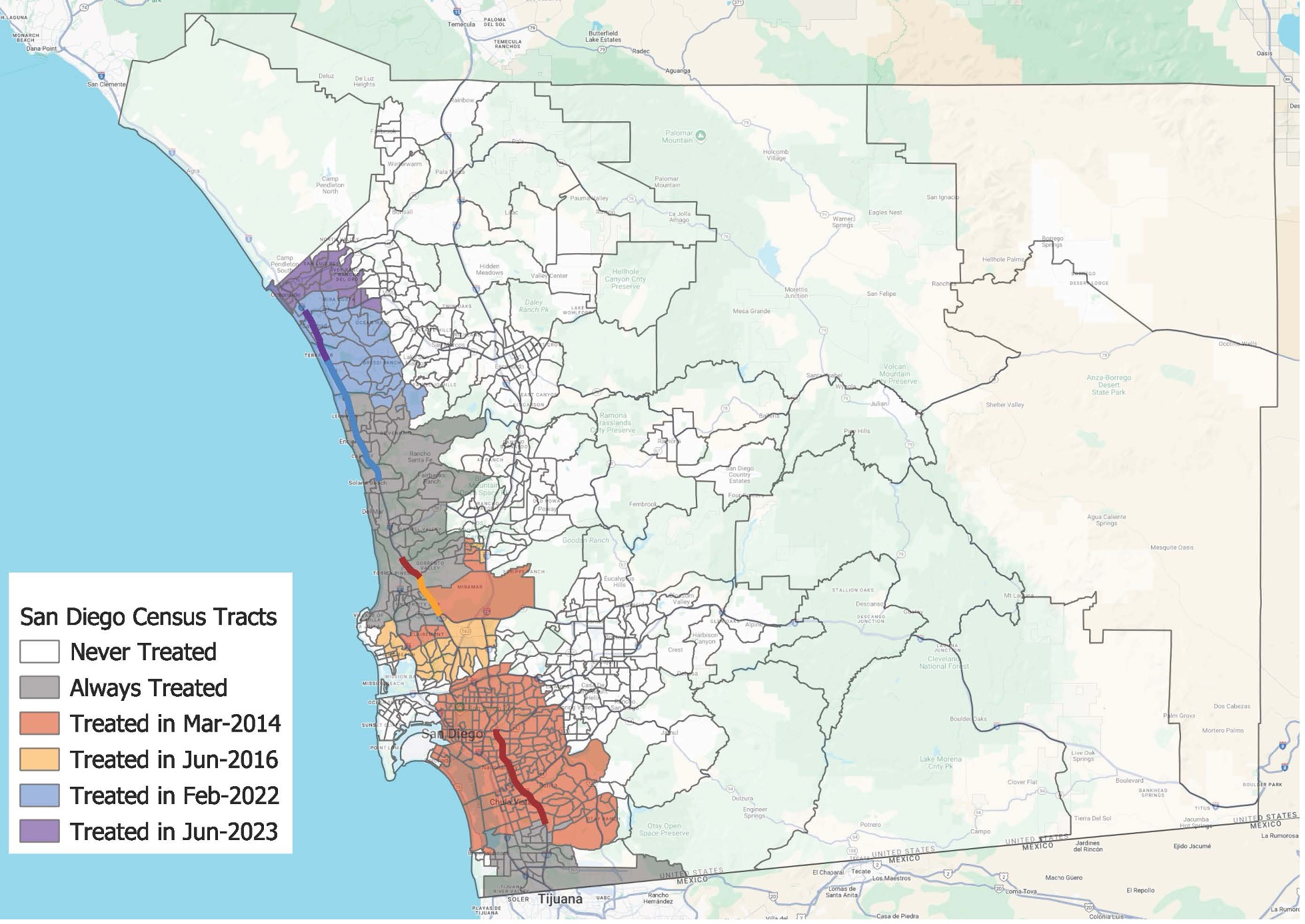
Figure 1. Illustration of HOV Treatment of Census Tracts in San Diego County.
Notes: This figure illustrates how we define the treatment of census tracts based on the addition of new HOV lane segments within 5 miles of the population centroid of a tract. The map shows all census tracts in San Diego County, color-coded according to their treatment status. Census tracts that are not colored were never treated because no operational HOV lanes were within 5 miles of their population centroid at any time between 2012 and 2024. Grey tracts are always treated, as operational HOV lanes were already within 5 miles of their centroids before the start of the observation period in 2012. Red tracts gained access to an HOV lane within 5 miles of their population centroid when new HOV segments were added to the HOV lane network in March 2014. Similarly, yellow tracts were treated following HOV lane additions in June 2016, blue tracts in February 2022, and purple tracts in June 2023. The map also includes the HOV lanes added to the road network during the sample period, color-coded to match the treatment of tracts. For example, red lane segments represent those that became operational in March 2014.
Our findings demonstrate a strong, positive, and statistically significant impact of HOV lane exemptions on EV adoption in California between 2012 and 2024. When a new HOV lane segment opened within five miles of a census tract’s population center, the tract-level EV market share rose by about 1.2 percentage points, an increase of roughly 16 percent relative to the average EV share at the time. Our results are robust to how we define HOV lane availability and proximity, specifically whether we use population rather than geographic centroids of census tracts and the choice of the distance threshold. We also find that the effects of HOV policies are not uniform across the state. The effect is strongest in tracts with higher shares of peak-time commuters and in those areas where commutes are more time-intensive, confirming that the value of HOV access stems from the time savings it provides.
Consumers may also be influenced not only by whether they have access to at least one HOV lane within their vicinity, but by the extent of HOV lane availability in their area. To capture this, our study looks beyond simple access and examines whether EV adoption increases as the number of nearby HOV segments increases. The results show that communities with more HOV lanes close by see higher EV adoption, suggesting that greater HOV lane availability also plays an important role in driving EV adoption.
A natural question, extending beyond prior research that focused on the early U.S. EV market, is whether and how the impact of HOV lane exemptions has changed over time as the market matured. Unlike in the early stages of the market, our study spans recent years with a more mature EV market, in which hundreds of EV models, including larger vehicle classes, are commercially available, battery technology has advanced considerably, charging networks have expanded substantially, and EVs are better understood by consumers. Our findings indicate that the policy had a larger impact in the later years of the study period, suggesting that as battery ranges improved, more EV models became available, and consumer awareness of EVs grew, drivers became increasingly responsive to non-financial incentives such as HOV access.
However, the distribution of benefits from HOV exemptions is uneven and reveals an important equity concern. We find that the estimated impact of HOV lane access is concentrated entirely in higher-income tracts, suggesting that the policy disproportionately encouraged EV adoption among wealthier households. This distributional pattern highlights that while HOV exemptions can be effective, they may also reinforce existing disparities in access to clean technology.
Link to the full working paper:
MIT CEEPR Working Paper 2025-21
About The Authors