


CEEPR Working Paper
2026-11
Lucas W. Davis, Jing Li, and Katalin Springel
This paper examines the relationship between political ideology and electric vehicle (EV) adoption in the United States, using detailed county-level data on new vehicle registrations in the U.S. from 2012 to 2023. Our data reveal a strong, persistent correlation between Democratic voting patterns and higher rates of EV adoption, raising important implications for climate policy and technology diffusion.
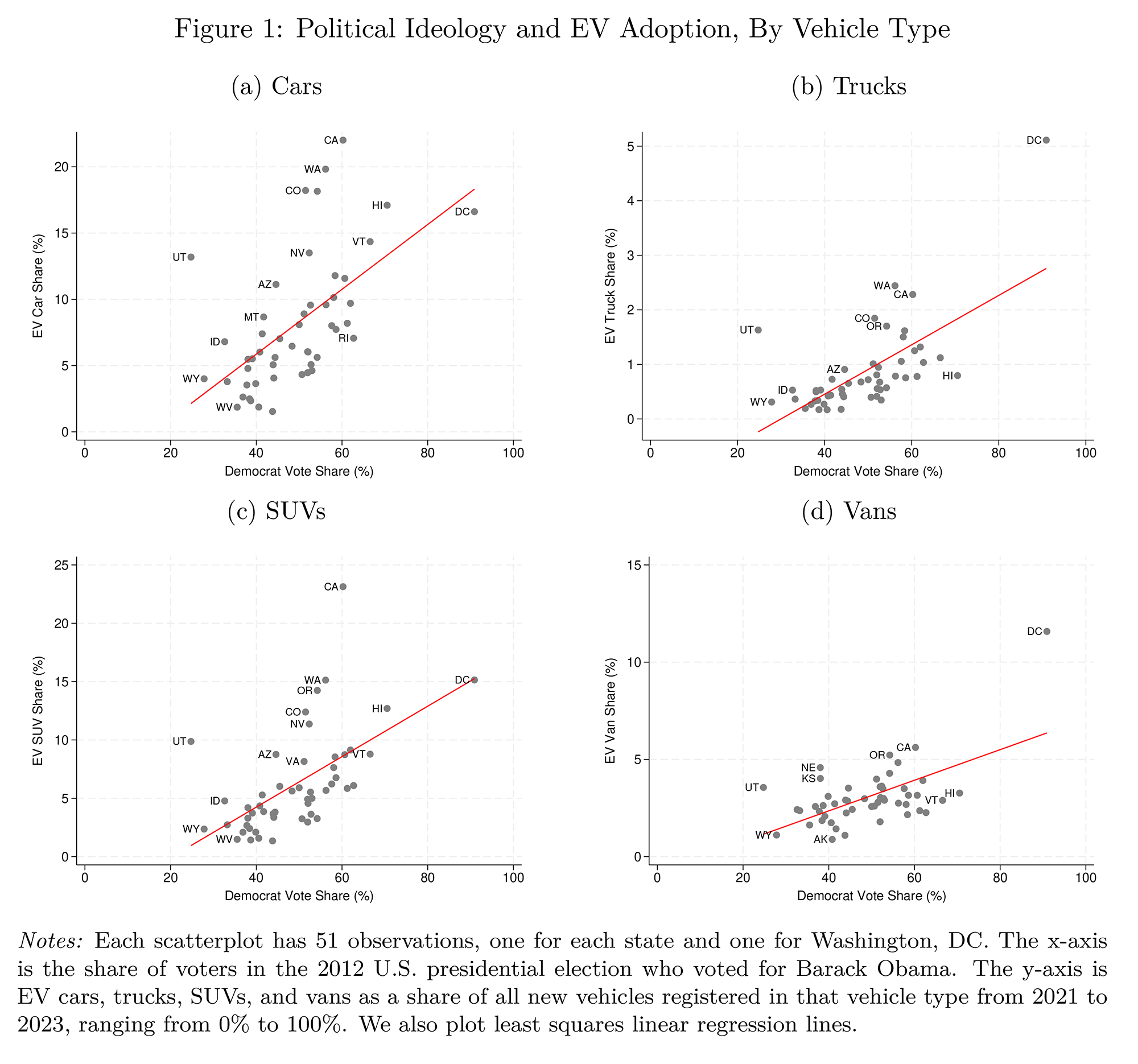
We begin by examining the new vehicle registration data at the state level from 2021 to 2023, when electric trucks and vans were brought to the market in meaningful numbers. Figure 1 shows the correlation between political ideology and EV adoption, separately by vehicle type. The x-axis is the Democrat vote share, and the y-axis is the share of that vehicle type that is electric. For example, in California, 23% of all new SUVs were EVs. Trucks are more popular in Republican-leaning areas, suggesting that introducing electric versions of trucks could help broaden EV adoption across the political spectrum. However, the positive association between political ideology and EV adoption is pronounced for all four vehicle types.
Turning to the data at the county level, we find that about half of all new EVs in the U.S. were registered in the 10% most Democratic counties, and about one-third went to the top 5%. These patterns remain stable over time, even as the EV market expanded dramatically in the range of offerings from manufacturers and in total units sold. Top U.S. counties for EVs are urban, high-income, and in Democratic states, such as California’s Bay Area, King County, WA, Multnomah County, OR, and Middlesex County, MA. By the end of our sample period, in 2023, 45% of EVs still went to the 10% most Democratic counties, and 32% still went to the top 5%. Overall, we find limited diffusion of EV adoption across the political spectrum.
The association between EV adoption and political affiliation is descriptive rather than causal. We cannot randomly assign political ideology to examine its impact on EV adoption. However, we can use regression analysis to control for other key economic and demographic factors, including household income, population density, and gasoline prices. We find that political affiliation is an economically and statistically meaningful determinant of EV adoption even after controlling for these other potential explanatory factors: …a one percentage point increase in Democrat vote share (e.g., going from 45% to 46%) is associated with a 0.026 percentage point increase in EV adoption (e.g., going from 1.0 percent to 1.026 percent). Mean EV share is less than 1 percent, so this is a large effect.
We then conduct a survey to examine whether a gap in knowledge about EVs can explain the differences in EV adoption between Democrats and Republicans. Our survey consisted of three parts. In the first part, respondents were shown images of vehicles and asked to classify them as EVs or non-EVs. The second part of the survey contained questions about EV knowledge, including charging and batteries. The third and last part of the survey asked about general automotive knowledge. Our survey revealed minimal differences between Democrats and Republicans in their ability to recognize EVs. While Democrats demonstrate slightly higher understanding of EV charging, they scored slightly worse on general automotive knowledge.
Our paper contributes to a broader literature on “green” consumption, which has identified two main mechanisms for how political ideology may factor into households’ consumption decisions. First, intrinsic motivations, such as environmental preferences or “warm glow” from reducing emissions, may differ across political groups. Second, extrinsic motivations, such as social signaling, may play a role. EV ownership could signal environmental identity in Democratic-leaning communities but carry less social value in Republican-leaning areas.
In this paper, we find that political affiliation is an independent and meaningful factor in U.S. households’ EV adoption decisions, even after controlling for other demographic and socio-economic variables. Given the persistence of the association between political affiliation and EV adoption from 2012 to 2023, political polarization may be a critical challenge for scaling green technology adoption. We emphasize that our findings are purely correlational and descriptive. To understand how to design policies that can bridge the partisan divide in green technology adoption, future work can delve further into the underlying motivations for EV adoption and how those motivations are determined by political affiliation.
Link to the full working paper and full citations:
MIT CEEPR Working Paper 2026-11
About The Authors